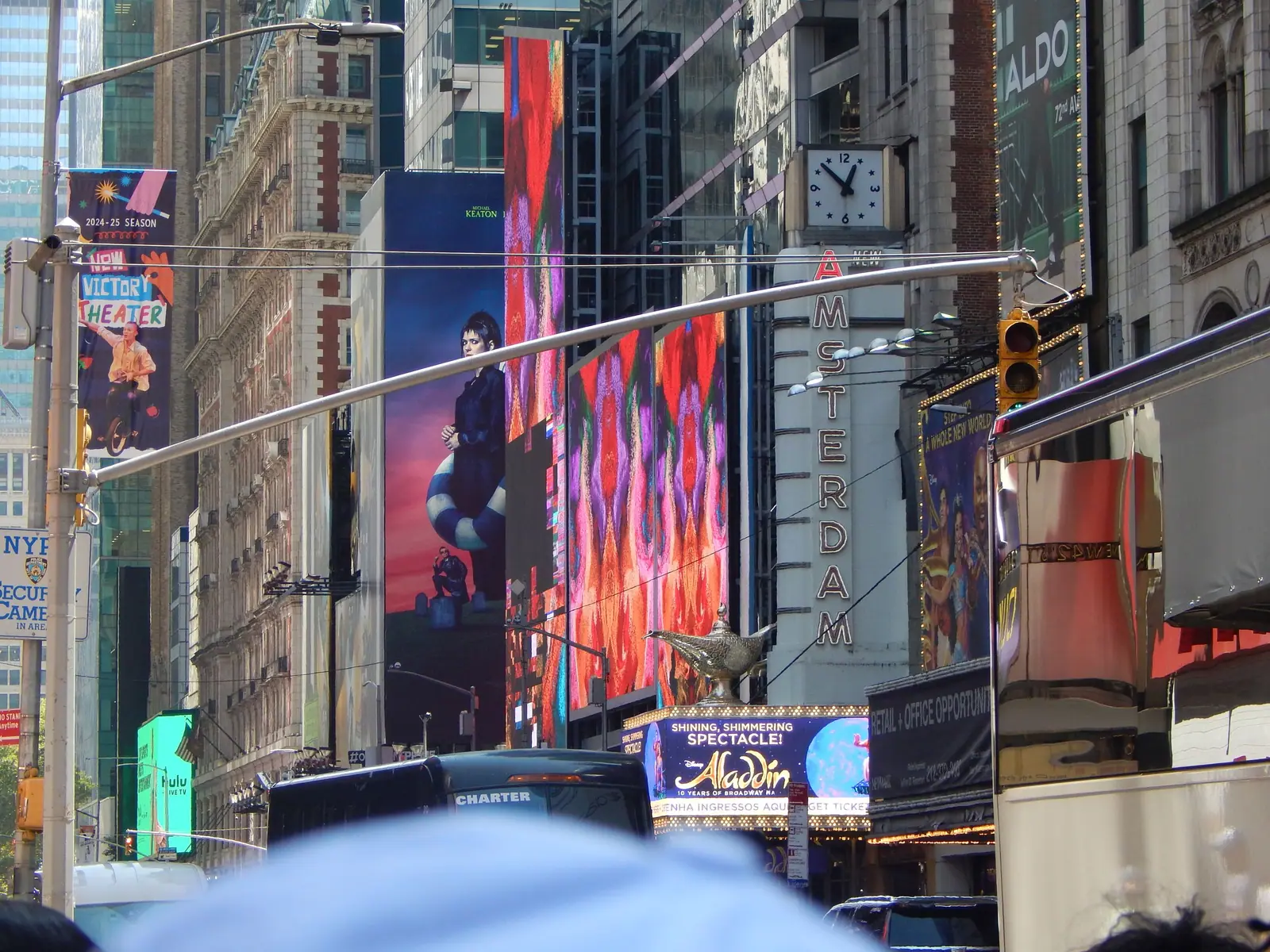
- Broadway houses
- About 40 in the district
- Evening curtains
- Typically 7 or 8 pm
- Location
- Midtown, west of Times Square
- Walk from Times Square
- A few minutes
What the Theater District is
The Theater District fills the blocks west of Times Square in Midtown, roughly between West 41st and West 54th Streets. Broadway's theaters are concentrated here: about 40 Broadway houses, with smaller off-Broadway rooms in the side streets. It is a working neighborhood as much as a night out, with offices, hotels and restaurants between the marquees. Most visitors arrive on foot from Times Square or from the subway, and the walk between one theater and the next is usually a few minutes.
The district took shape in the late 19th century, when theaters moved north from Lower Manhattan toward Longacre Square, which was renamed Times Square in 1904. Grand Central Terminal and Penn Station brought audiences by rail, and the cluster of houses around the square held through the 20th century. Many theaters have been restored rather than replaced, so several auditoriums are older than the shows on their stages. The district remains the center of commercial American theater, and the off-Broadway rooms nearby draw on the same pool of actors and crews.
Choosing a Broadway show
Choosing a show starts with the two broad categories: musicals, which usually mean larger sets and bigger casts, and plays, which often have shorter runs and smaller companies. Look at the run dates rather than the poster, since long-running shows and limited engagements sell differently. Check the running time, the age guidance and whether the seats on offer give a full view of the stage. Reading two or three reviews from different outlets helps more than a single quote on a marquee.
Buy from the theater's own box office or an authorized seller, and treat unsolicited offers on the street as a warning sign. Same-day discounts exist for some performances, usually through official channels in Times Square and online, but availability changes daily. Popular shows in holiday weeks can sell out weeks ahead, while a Tuesday or Wednesday evening in February is easier to book. If a show is sold out, ask about returns and cancellation lines at the box office, then look at what else is playing nearby.
- Check the running time and whether there is an intermission before booking.
- Look at a seating plan, since side seats in older houses can have restricted views.
- Age guidance matters for long evening shows, especially with younger children.
- Confirm the curtain time on the day, because schedules change.
Getting to the Theater District
The Theater District is well connected to the rest of Manhattan. Several subway lines meet at Times Square and at 42nd Street, so most journeys need no more than one change, whichever borough you start from. The subway runs 24 hours a day, and fares are paid by tapping a contactless card or phone at the turnstile. Weekend and evening service changes are common, so check the current status with the transit authority before you set out.
Regional trains arrive at Grand Central Terminal on 42nd Street at Park Avenue and at Penn Station on 34th Street between Seventh and Eighth Avenues, both a short walk from most theaters. Buses stop at the Port Authority Bus Terminal at 42nd Street and Eighth Avenue. From JFK, the AirTrain connects to rail and subway services; from Newark, the AirTrain links to trains into Penn Station. LaGuardia is closest by road, and the free Q70 bus connects to the subway.
When to go and how long
Evening curtains are typically at 7 or 8 pm, with matinees on some days, so check the show rather than assuming. Weekends and school holidays are the busiest, and December is the busiest holiday period of the year. January to early March is usually the quietest stretch, which makes it the easiest time to find seats at short notice. Spring and autumn are the mildest seasons for the walk to and from the theater.
Allow more time than the performance itself. Bag checks at the doors, the crush in the lobby and the search for your seat all take longer than the running time suggests, so plan to arrive well before the curtain. Running times vary by show, and a musical with an intermission fills an evening. After the final curtain, the sidewalks outside the larger houses empty slowly, so expect a slow walk to the subway or a short wait at the stage door.
Dress, crowds and photography
There is no dress code at Broadway theaters, and audiences wear everything from jeans to jackets. Comfortable shoes matter more than a collar, since you will likely walk several blocks and stand in a lobby. Some houses have narrow rows and steep stairs, so a light layer helps in warm auditoriums. Larger theaters offer a coat check in winter, and it is worth using if you plan to walk afterward.
Photography rules are simple: no pictures or recording during the performance, and phones should be silent and out of sight. Photographs in the lobby and of the marquee outside are fine. After the curtain, the area around Times Square becomes very crowded, with pedestrians, costumed characters and traffic. Keep to the inside of the sidewalk, cross with the lights, and walk a block or two west or east before looking for a subway entrance.
- Silence phones before the curtain and keep them away during the performance.
- Skip large bags where you can, since bag checks slow entry at busy houses.
- Wait for the aisle to clear before leaving, because the exits jam quickly.
- Keep the ticket or confirmation handy for the door staff.
Nearby sights and where to stay
Times Square sits at the center of the district and is best seen briefly, ideally after dark when the signs are brightest. Rockefeller Center and Fifth Avenue are a short walk east, with the skating rink and the Christmas tree in winter. Central Park begins at 59th Street, and Museum Mile runs up Fifth Avenue from about 82nd Street. Bryant Park and the New York Public Library sit to the south, and the public spaces there are free.
For a short stay, Midtown around the district keeps everything within walking distance, though rooms are in demand in peak weeks. Hell's Kitchen, west of Eighth Avenue, is quieter and still close enough to walk. The Upper West Side is a subway ride away and calmer at night, and Lower Manhattan suits travelers who want a different part of the city as a base. Hotel bills add state and city taxes and a nightly occupancy charge, so check the total price with taxes and fees.
Broadway and the Theater District: questions
Where is the Broadway Theater District in Manhattan?
It sits in Midtown, west of Times Square, roughly between West 41st and West 54th Streets. About 40 Broadway houses are clustered there, with smaller off-Broadway rooms in nearby side streets. Most theaters are within a few minutes' walk of the Times Square and 42nd Street subway stations, and the streets between them are easy to cross on foot.
How do you choose a Broadway show?
Start with the form, a musical or a play, then check run dates, running time and age guidance rather than the poster alone. Read two or three reviews from different outlets. Buying through the theater's box office or an authorized seller is safest, and same-day discounts appear through official channels, subject to daily availability.
What time do Broadway shows usually start?
Evening curtains are typically at 7 or 8 pm, with matinees on some days of the week. Schedules differ by show and change with the season, so confirm the curtain time with the production on the day you go rather than relying on an old listing or a printed schedule picked up earlier in the trip.
How do you reach Broadway and the Theater District by subway or train?
Several subway lines meet at Times Square and 42nd Street, so most trips need one change at most. Grand Central Terminal and Penn Station are both a short walk from the theaters, and the Port Authority Bus Terminal is at 42nd Street and Eighth Avenue. Check current service before traveling, since weekend changes are common.
Do you need to dress up for a Broadway show?
No. There is no dress code, and audiences wear everything from jeans to jackets. Comfortable shoes matter more than formal clothes, because you will walk several blocks and stand in a crowded lobby. A light layer helps in warm auditoriums, and larger theaters offer a coat check in winter.
Can you take photographs at a Broadway theater?
Not during the performance. Photography and recording are not allowed once the show begins, and phones should be silent and out of sight. Photographs in the lobby and of the marquee outside are fine. After the curtain, the streets around Times Square are crowded, so keep cameras close and step out of the traffic flow.
How long should you allow for a night at Broadway and the Theater District?
Allow more than the running time. Bag checks, lobby crowds and finding your seat take time, so arrive well before the curtain. Running times vary by show, and a musical with an intermission fills an evening. Afterward, allow extra time for the crowded sidewalks and the walk back to the subway.
Where should you stay near Broadway and the Theater District?
Midtown around the district keeps the theaters within walking distance, though peak weeks are busy. Hell's Kitchen, west of Eighth Avenue, is quieter and still walkable. The Upper West Side is a short subway ride away, and Lower Manhattan gives a different base. Compare the total price with taxes and fees, not the headline rate.