- Address
- 42nd Street at Park Avenue
- Opened
- 1913, in Beaux-Arts style
- Nearest areas
- Murray Hill and Kips Bay
- Allow
- 30 minutes to an hour
What the terminal is
Grand Central Terminal stands at 42nd Street and Park Avenue, at the point where the street grid meets the avenue that carries trains into the city from the north. It is a terminal, not a station: trains arrive and leave from the same tracks, and the concourse is the end of the line rather than a platform on a through route. The building opened in 1913 in the Beaux-Arts style, replacing an earlier depot on the same site, and it remains a working commuter rail terminal.
In the 1960s and 1970s the terminal faced demolition, as the air rights above it were sold for redevelopment. A long preservation campaign ended in the courts, and the ruling that saved the building became a landmark in American preservation law. The rescue shaped what you see today: the concourse was cleaned, the ceiling repainted, and unused upper floors turned over to events and dining. Commuters and visitors still share the same hall, which is why the building never feels like a museum.
The main concourse
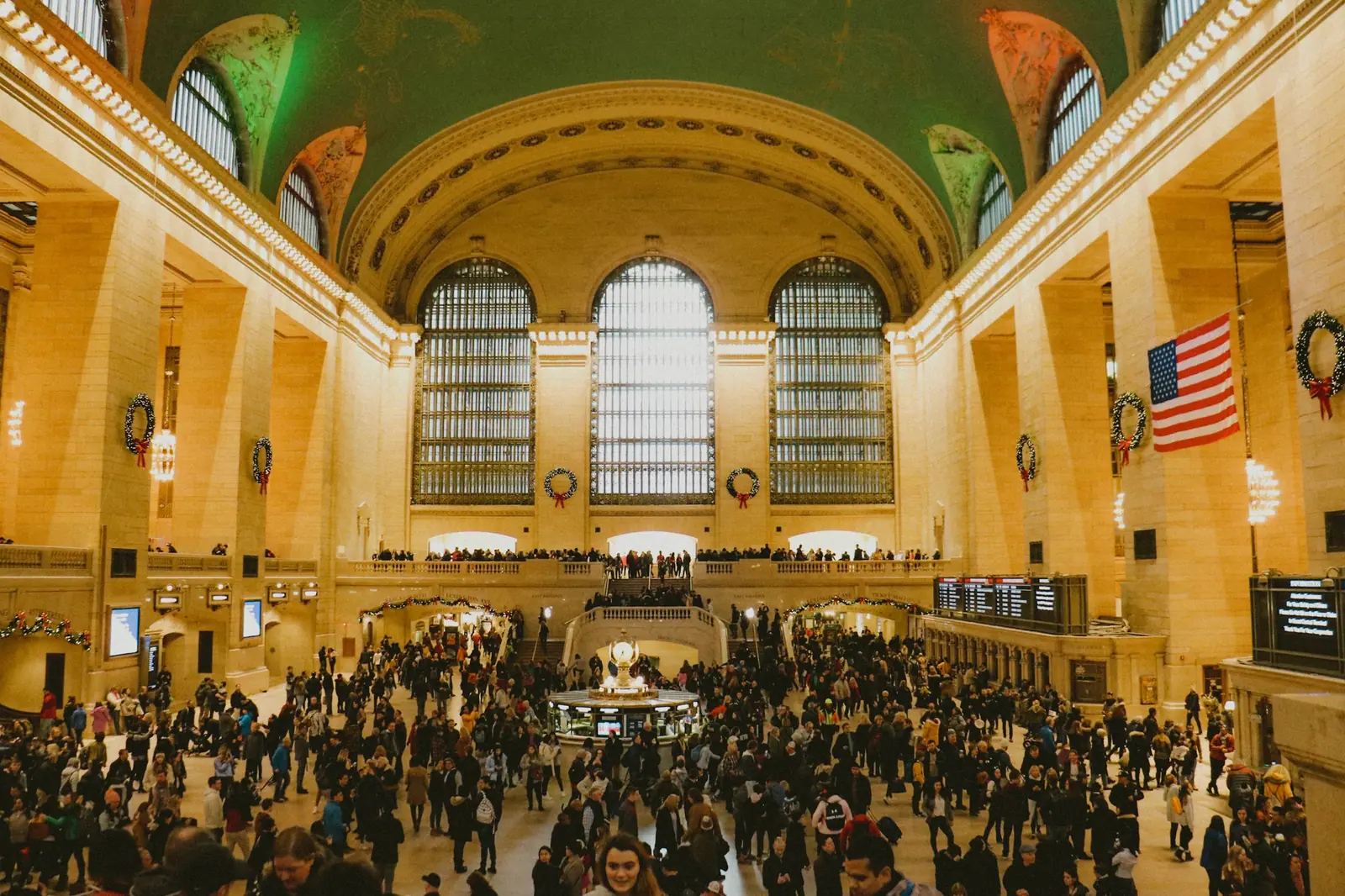
The main concourse is the reason most people come. It is a single room of improbable height, lit by three enormous arched windows on the south side and by chandeliers hung high above the floor. In the middle stands the information booth, topped by a four-faced clock that has served as a meeting point for generations of New Yorkers. Ticket windows and entrances line the walls, and balconies run along the east and west sides, reached by stairs and elevators.
Look up. The ceiling carries a painted sky of constellations, gold figures on a soft green ground, running from one end of the hall to the other. The scheme is one of the surprises of the building: a working rail terminal dressed as a night sky. A restoration in the 1990s brought back the original colors and removed decades of soot. The figures are commonly described as reversed, drawn as though seen from outside the sky rather than from the ground.
Details most people miss
Below the main floor is a second concourse, quieter and lower, built for suburban trains and now given over to food counters and long tables. Walk to its far end and you reach a tiled arched passage where a word spoken into one corner carries clearly to the other, a trick of the curved ceiling that visitors have used for decades. At the west end of the main hall, broad ramps climb to street level, built so that cars and taxis could drive into the building.
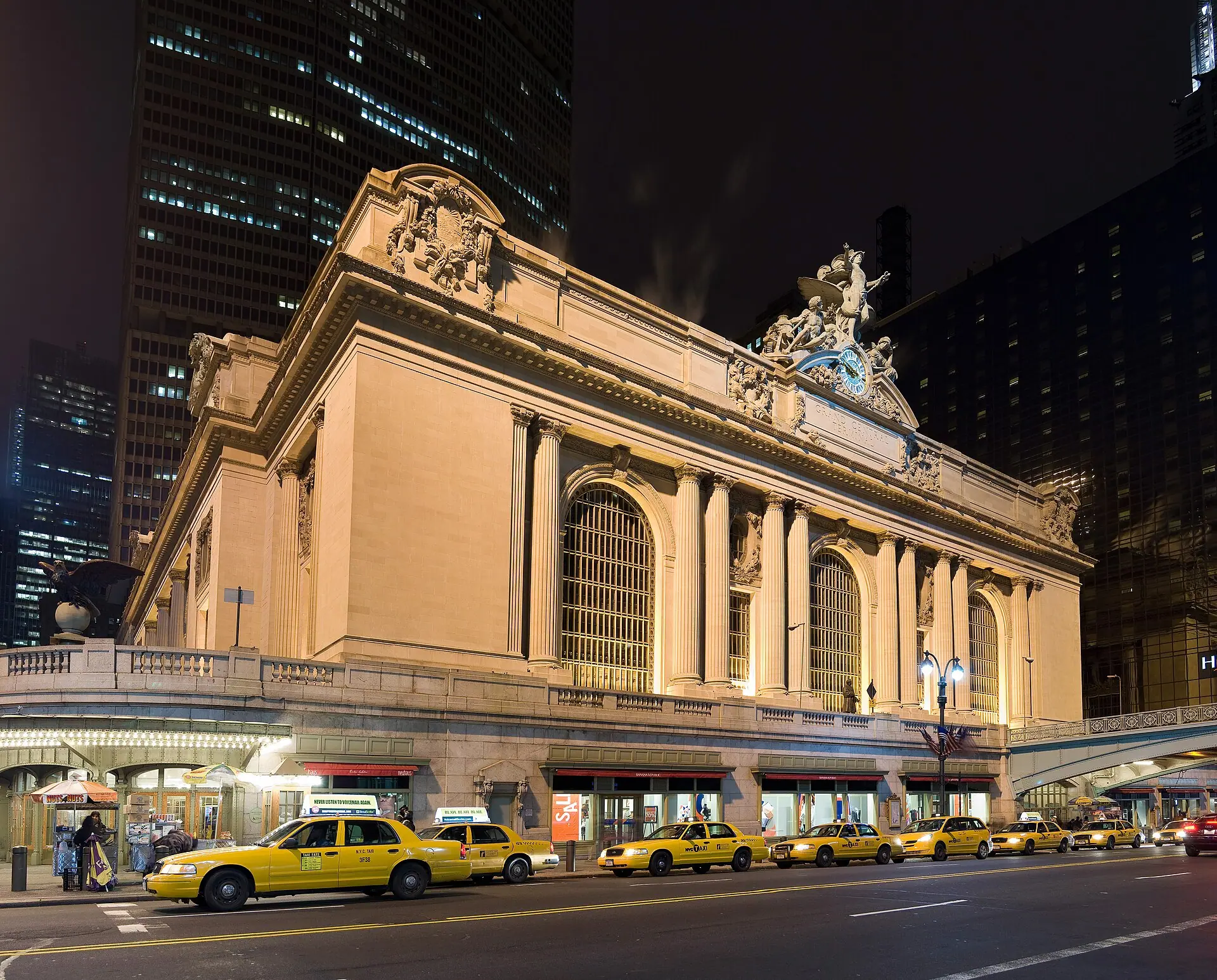
Outside, the south facade on 42nd Street is worth the walk. A sculptural group stands over the great clock, and the stone eagles along the roofline look down on the traffic. The Park Avenue viaduct wraps around the building, carrying the avenue past the facade and over 42nd Street, so that cars pass at first-floor height. On the west side, a former waiting room with tall windows and a decorated ceiling now hosts events and exhibitions; its doors are usually open.
- The four-faced clock on the information booth is the traditional meeting point, so arrange to meet under it rather than at a door.
- Broad ramps at the west end of the concourse climb to the street and give a raised view back across the floor.
- The lower level holds a tiled arched passage where a whisper carries across the curve to the opposite corner.
- Above the south entrance on 42nd Street, a sculptural group and a large clock face look down on the avenue.
Getting there and when to go
The terminal stands at 42nd Street and Park Avenue, with entrances on 42nd Street, on Park Avenue and from the surrounding streets. Several subway lines stop here, and the Times Square stops are a short walk west along 42nd Street. Commuter trains run north from the terminal into the city's northern suburbs and beyond. Fares on the subway are paid by tapping a contactless card or phone at the turnstiles. Check current fares and planned service changes with the MTA before you travel.
Go early on a weekday for the quietest floor and the best light through the south windows; the hall fills between about eight and nine in the morning and again in the evening. Weekends are steadier, and late evening is calm. Allow half an hour for a walk through the main hall, and an hour or more if you want the lower level, a balcony and a look at the facade. The building stays open from early morning until well after the evening rush; individual shops and food counters keep their own hours.
Nearby sights
The terminal sits on the east side of Midtown, where Murray Hill and Kips Bay begin to the south and east and Midtown East runs north along Park Avenue. The grid makes the area easy to read: 42nd Street runs east to the East River and west to Times Square, while Park Avenue runs north through the east side of the island. Fifth Avenue, with its shops and its library, is a short walk west, and the streets between are busy at lunchtime on weekdays.
Bryant Park lies directly west of the terminal, a green square behind the main building of the New York Public Library, whose stone lions face Fifth Avenue. Times Square and the Theater District begin a few blocks west along 42nd Street. The Empire State Building stands south on Fifth Avenue, with an open-air observation deck on the 86th floor. Rockefeller Center is a short walk west and north, and the United Nations headquarters is east along 42nd Street at First Avenue.
- Bryant Park sits directly west of the terminal, behind the New York Public Library's main building on Fifth Avenue.
- The Empire State Building is a short walk south on Fifth Avenue, with an open-air deck on the 86th floor.
- Times Square and the Theater District begin a few blocks west along 42nd Street, where evening curtains are usually at 7 or 8 pm.
- The United Nations headquarters stands at the east end of 42nd Street, on First Avenue.
Practical tips and where to stay
Dress for the weather. The walk between the street and the platforms is short, but the queues at the doors and the walk to nearby sights are outdoors, and the hall itself can feel cool in winter and warm in summer. Photography is generally allowed in the public areas; keep out of the flow of commuters, avoid blocking staircases and ask before photographing people. Rush hours are for passing through, not for standing still in the middle of the floor.
Hotels cluster in Murray Hill and Midtown East within a short walk of the terminal, and in Midtown to the west; Kips Bay has quieter streets to the south east. Rooms near a major terminal suit early trains and late arrivals. New York hotel bills add state and city taxes and a per-night occupancy charge to the room rate, and some hotels add a facility fee. Check the total price with taxes and fees before booking.
Grand Central Terminal Visitor Guide: questions
Is Grand Central Terminal free to visit?
Yes. The concourse, the balconies and the lower level are open to anyone, and you pay only for trains, food or shopping. Fares for commuter and subway trains change, so check the current fare with the MTA before you travel. Allow half an hour at least.
When is Grand Central Terminal quietest?
Early on a weekday, before the morning rush, and again late in the evening. The hall fills between about eight and nine in the morning and through the evening rush, and weekends are steadier. December is the busiest month for visitors, so expect company around the holiday season.
How long should you allow for a visit to Grand Central Terminal?
Half an hour covers the main concourse, the clock and the ceiling. Allow an hour or more if you want the lower level, a balcony view and a look at the south facade on 42nd Street. Add time for Bryant Park and the library next door.
How do you reach Grand Central Terminal by public transport?
Several subway lines stop at the terminal, and the Times Square stations are a short walk west along 42nd Street. Commuter trains run north from the terminal, and buses run along 42nd Street. Subway fares are paid by tapping a contactless card or phone; check current fares and service changes with the MTA.
Can you take photographs inside Grand Central Terminal?
Photography is generally allowed in the public areas of the concourse and the balconies. Keep out of the flow of commuters, avoid blocking stairs and doors at rush hour, and ask before photographing people. Events in the building sometimes restrict access to parts of the hall, so check on the day.
What is painted on the ceiling of Grand Central Terminal?
A sky of constellations, painted in gold on a soft green ground, running the length of the main concourse. The figures are commonly described as reversed, as though seen from outside the sky. A restoration in the 1990s brought back the original colors after decades of soot and smoke.
Where should you stay near Grand Central Terminal?
Murray Hill and Midtown East are within a short walk, and Midtown to the west has more rooms. Kips Bay, to the south east, is quieter. New York hotel bills add state and city taxes and a per-night occupancy charge, and some hotels add a facility fee, so check the total price with taxes and fees before booking.
What can you see within walking distance of Grand Central Terminal?
Bryant Park and the main building of the New York Public Library are directly west, with the library's stone lions facing Fifth Avenue. Times Square and the Theater District are a few blocks west along 42nd Street. The Empire State Building is south on Fifth Avenue, and the United Nations headquarters is east at First Avenue.