- Location
- West 30s, by the Hudson
- Nearest areas
- Chelsea and Penn Station
- High Line
- North end at West 34th Street
- Allow
- Half a day including the High Line
What Hudson Yards is
Hudson Yards is a district on the far West Side, roughly between Tenth and Eleventh Avenues and West 30th and West 34th Streets. Its towers stand on a platform built over the West Side Yard, a working rail yard where commuter trains are stored between runs. That engineering is the reason the streets here feel new: the ground beneath them is a deck, not the original shoreline. The result is a dense cluster of offices, homes and public space at the north end of the High Line.
The district was planned in the 2000s and built in stages through the late 2010s, together with a subway extension that put a station at its center. Public space, an observation deck and cultural buildings opened alongside the offices. Hudson Yards is not a historic neighborhood and does not try to look like one. It is a piece of city made from scratch on top of infrastructure, and it reads that way. Visitors come for the architecture, the views and the river light rather than for old streets.
What to see at Hudson Yards
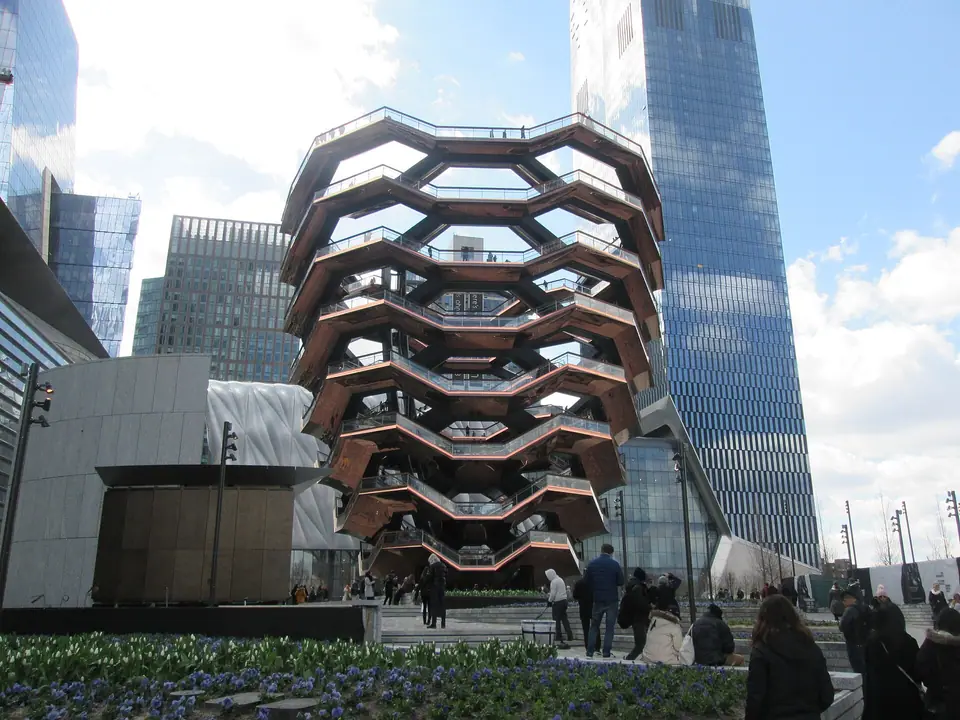
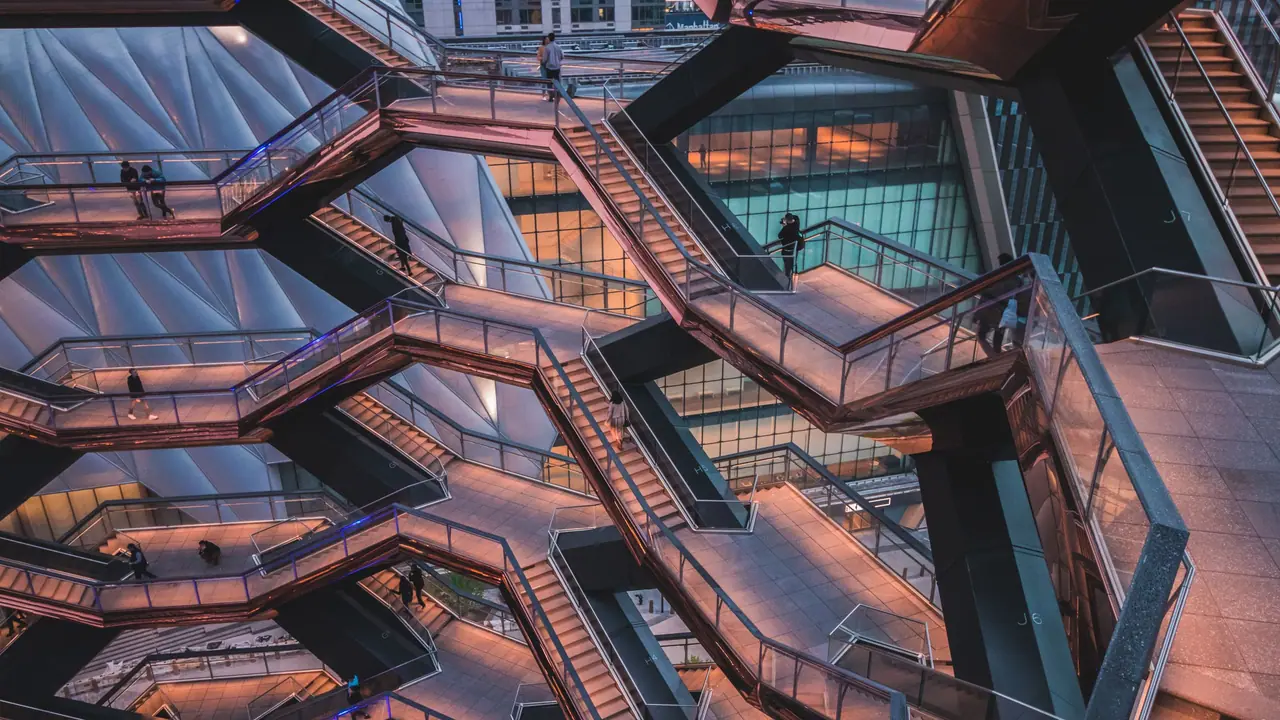
The Vessel stands at the middle of the public square: a copper-colored structure of interlocking staircases and landings, designed by Thomas Heatherwick, that you walk into rather than simply look at. Around it are towers by several architects, a covered shopping hall, and a cultural building with a movable outer shell that hosts exhibitions and performances. The square itself is free and open, and it is the easiest place in the district to sit down, look up and take stock.
The Edge is the district's observation deck, on the 100th floor of one of the towers, with an outdoor terrace and a glass floor section. An entry fee applies and timed tickets are the norm, so book ahead if a particular sunset matters. From the deck the view runs over the Hudson, the High Line and the grid of the West Side. Access to the Vessel itself has changed more than once since it opened; check the current rules before planning a climb.
- The Vessel, the district's stair sculpture, seen from the square below.
- The Edge observation deck, with its outdoor terrace and glass floor.
- The cultural building with a movable shell, which hosts changing exhibitions and shows.
- The High Line entrance at West 34th Street, a short walk from the square.
How to get to Hudson Yards
The simplest approach is by subway. The Hudson Yards station on the 7 line sits at the edge of the district and connects to Grand Central and Times Square. From Penn Station the walk is short and mostly level, along West 34th Street or through the streets to the south. Several bus routes run along 34th Street. Check the MTA's service information before you travel, since weekend work can change routes and station access.
Arriving on foot from the south is the better experience. The High Line ends at West 34th Street beside the district, so you can walk the park up from Chelsea and come out at the yards with the towers rising ahead. From the Theater District or Herald Square, West 34th Street is a straight walk west. Driving is possible, but the district sits inside the congestion pricing zone, where a toll applies to vehicles entering Manhattan below 60th Street. Check the current rules with the city.
When to go and how long
Spring, from April to June, and autumn, from September to November, are the mildest seasons and the most comfortable for walking the High Line and the waterfront. Summer is hot and humid, and the square and the decks offer little shade. Winter is cold, with snow in some years; the wind off the Hudson makes the open spaces feel sharper. December is the busiest holiday period, and January to early March is usually the quietest.
Allow half a day if you want the High Line as well as the district, and two to three hours for the square and one observation deck. Weekday mornings are calmer than weekends, and the square fills toward sunset, when the light on the towers is at its strongest. Manhattanhenge, when the setting sun lines up with the cross streets, falls a few days a year, usually in late May and mid-July; the crowd is thick on those evenings.
- April to June and September to November, for mild weather and long walks.
- Weekday mornings, when the square and the High Line are quieter.
- Late May and mid-July, for Manhattanhenge on the cross streets.
- January to early March, the quietest stretch of the year.
Nearby sights
The High Line is the obvious companion. Its northern stretch runs from the district south through Chelsea to Gansevoort Street, with planted beds, benches and views into the streets below. Hudson River Park follows the waterfront a short walk west, with a continuous path along the water. Chelsea adds galleries, market halls and older residential blocks. Penn Station and Moynihan Train Hall are a walk east, and the Theater District is a short ride or a longer walk north.
For a sense of scale, pair the district with a second observation deck. One World Observatory is at the southern tip, Top of the Rock is at Rockefeller Center, and the Empire State Building has an open-air deck on the 86th floor and another higher up. Each shows a different face of the island. The Staten Island Ferry, free and leaving from Whitehall Terminal, gives a water-level view of the harbor and passes the Statue of Liberty.
Practical tips for Hudson Yards
Dress for the wind. The district stands close to the Hudson, and the space between the towers funnels a breeze, so a layer more than you expect helps, especially on an observation deck. Comfortable shoes matter more than style: the High Line, the square and the station corridors add up to a lot of walking. Bring water in summer, when shade is scarce and the paved surfaces hold heat.
Photography is easy here, but the geometry is the draw: the Vessel's diagonals, the High Line's rails, the river light behind the towers. Sunset and the hour after it give the best contrast, and a weekday morning gives you the square with fewer people in the frame. Check the rules on tripods and professional equipment before you go, since observation decks and the park set their own conditions. Keep the pace slow and look up.
Hudson Yards and the Vessel: questions
Is Hudson Yards free to visit?
The streets, the public square and the High Line cost nothing to walk through, and the Vessel is viewed from the square at no charge. The Edge observation deck is ticketed, and an entry fee applies. Check current access rules for the Vessel before you go, since they have changed more than once.
What is the Vessel at Hudson Yards?
The Vessel is the stair sculpture at the center of the public square, a honeycomb of interlocking flights and landings clad in copper-colored steel and designed by Thomas Heatherwick. It opened with the first phase of the district and became its recognizable image. It is a structure to look at and, when access allows, to climb.
Can you climb the Vessel at Hudson Yards?
Access has changed several times since the structure opened, and climbing has been suspended and reinstated in different forms. There is no reliable rule of thumb. Check the operator's current information, and the notices at the square, on the day you plan to visit. Even when the stairs are closed, the structure is visible from the public square.
How do you get to Hudson Yards by subway?
The Hudson Yards station on the 7 line puts you at the edge of the district, with connections at Grand Central and Times Square. From Penn Station the walk is short and mostly level. Check the MTA's service information before traveling, since weekend work can affect routes and station access.
How long should you spend at Hudson Yards?
Allow two to three hours for the public square and one observation deck, and half a day if you add the High Line. Add more if you continue to Hudson River Park or walk down through Chelsea. Sunset visits take longer, because the deck and the square both fill up.
When should you visit Hudson Yards?
Spring and autumn are mildest, and weekday mornings are calmest. Sunset gives the strongest light on the towers and the river, and the public square fills accordingly. December is the busiest holiday period, while January to early March is usually the quietest stretch of the year.
Where can you stay near Hudson Yards?
Chelsea to the south, the West 30s around Penn Station and Herald Square, and the Theater District to the north all put the district within walking distance. Hotel bills add state and city taxes and a per-night occupancy charge, and some hotels add facility fees, so check the total price with taxes and fees.
Is Hudson Yards good for photography?
The geometry rewards a camera: the Vessel's diagonals, the High Line's rails and planting, and the river light behind the towers. Sunset and the hour after it give the strongest contrast. A weekday morning keeps other people out of the frame. Check the rules on tripods and professional equipment, since the decks and the park set their own conditions.