- Type
- Public parks, free entry
- Location
- West Side waterfront, Manhattan
- Little Island
- Opened May 2021
- Path length
- Roughly four miles
What Little Island is
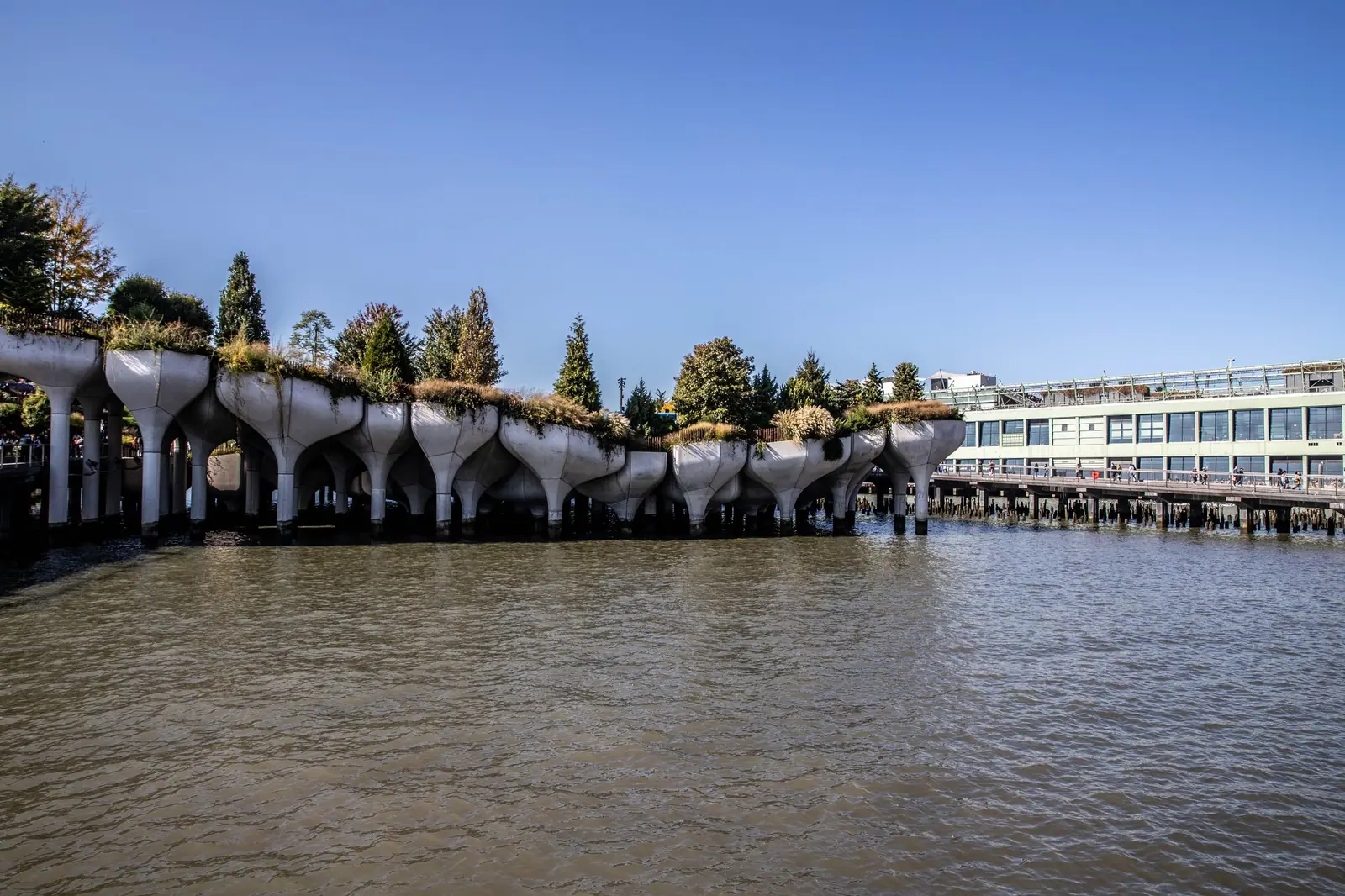
Little Island is a public park on the Hudson River at the foot of West 13th Street, built on a cluster of concrete piles that rise from the water. It opened in May 2021 on the site of Pier 55, a project funded by Barry Diller and Diane von Furstenberg. Thomas Heatherwick designed it with landscape architects. The park sits on the water rather than beside it, held above the river on tulip-shaped columns of different heights.
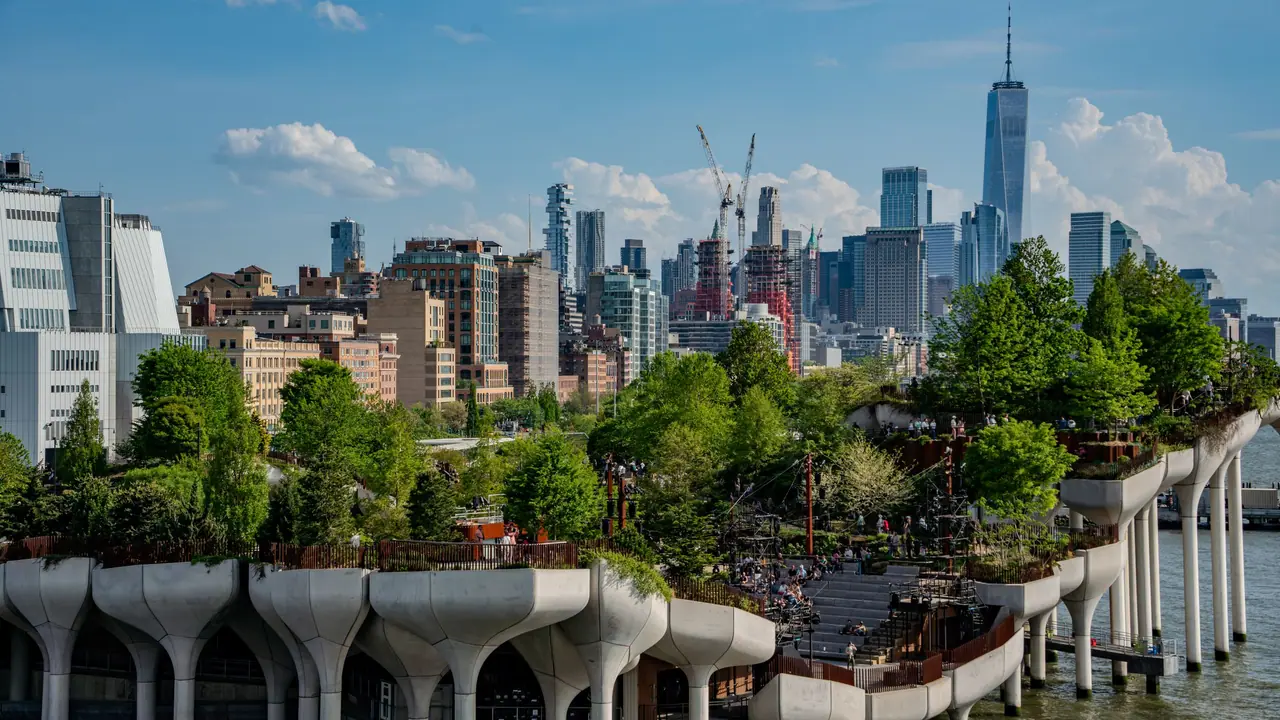
On top, paths loop through planted slopes of trees, shrubs and perennials, past a small amphitheater and a lawn, with lookout points over the river. The park is compact, so a circuit takes only a short while, and the pleasure is in the planting, the water on all sides and the view back to the city. Entrances open off the waterfront esplanade. Entry is free, and the park sometimes uses timed entry at busy hours, so check its own site before you set out.
The riverside path and piers
Hudson River Park runs along the West Side from Battery Park up to 59th Street: roughly four miles of esplanade, piers, lawns and gardens on the river. It was created under the Hudson River Park Act of 1998, which set the waterfront aside for public use as the old shipping piers declined. The path is the spine of it, a broad, level walkway for walking, running and cycling that stays close to the water almost the whole way.
Along the way, piers reach out into the river. Some carry lawns and benches, some have playgrounds and sport courts, and the esplanade between them opens views across to New Jersey and south toward the harbor. Newer sections, including the Gansevoort Peninsula near the West Village, add open lawns and a sandy edge. The Hudson River Greenway cycle path runs the length of the park, so look both ways when you cross it, and keep to the walking side of the esplanade.
Getting there
The park runs along the West Side, so it is easy to reach on foot from the West Village, Chelsea and the Meatpacking District. Subway stations on 14th Street and at Christopher Street put you within a few blocks of the water, and buses run along the avenues behind the waterfront. From most streets in these neighborhoods you walk downhill and west until the buildings stop and the river opens up.
By bike, the Hudson River Greenway carries you onto the esplanade from the north and south, and racks stand near the entrances. Drivers should expect congestion pricing for entries below 60th Street, and parking near the waterfront is scarce at any hour of the day. On foot, the walk from either subway station is short and level. Little Island sits directly off the esplanade at West 13th Street, so any walk along this stretch of Hudson River Park passes it, and you can step off the path and into the park.
- Walk west on West 13th Street to reach the Little Island entrance from the street grid.
- Subway stations on 14th Street and at Christopher Street are the closest to the waterfront.
- The Hudson River Greenway cycle path runs the length of Hudson River Park.
When to go and how long
Spring and autumn are the mildest seasons, and the waterfront is at its best from April to June and from September to November. Summer afternoons are hot and humid, with little shade on the open piers; mornings and evenings are cooler. Winter is cold and windy on the water, though the paths stay open and the views are clear. Little Island's planting changes through the year, so the park looks different on each visit.
Give Little Island an hour or so and the riverside path as long as you can spare; half a day covers both at an easy pace, with time to sit on a pier. Weekday mornings are quietest. Weekend afternoons in summer and around the holidays draw the largest crowds, and sunset is the busiest and most photographed hour on the esplanade. The park's own site lists current opening hours and any timed entry.
Practical tips for a visit
Wear shoes you can walk in. The esplanade itself is flat, but the distances add up, and Little Island's paths climb and dip across its slopes. Bring a layer for the wind off the river, which is stronger out on the piers than on the streets a block inland. Shade is scarce over the water in the middle of the day, so a hat and a bottle of water help in summer. In winter, gloves and a warm coat make the walk comfortable.
For photographs, the light is best early and at sunset. Little Island's columns and the water behind them photograph well from the esplanade and from the piers to the north and south. Check the rules posted at the entrances before setting up a tripod, and note that drones are usually not welcome in the parks. Crowds thin after the evening rush on weekdays. Carry out what you bring, since bins on the piers are few.
- Little Island's paths climb and dip on their slopes, so steps are part of the visit.
- The wind off the Hudson is stronger on the piers than on the streets behind them.
- Shade is scarce on the open piers in summer; carry water and a hat.
- Sunset is the most popular hour for photographs from the esplanade.
Nearby sights and places to stay
Inland from the water, the High Line begins near Gansevoort Street and runs north on an old rail viaduct, and the Whitney Museum of American Art sits at its southern end. Washington Square Park and the streets of the West Village are a short walk east. Chelsea's galleries and the market halls at Chelsea Market lie north of 14th Street. The 9/11 Memorial, Battery Park and the Staten Island Ferry are a longer walk or a short subway ride south along the path.
For a stay, the West Village and Chelsea put you within a few minutes of the water, and the Meatpacking District is closest of all to Little Island. Greenwich Village and SoHo are a longer but walkable addition. Hotel bills in New York City add state and city taxes and a per-night occupancy charge, and some hotels add facility or destination fees, so check the total price with taxes and fees before booking. This site shows no prices; every booking button opens live prices in the IMPT app.
Little Island and Hudson River Park: questions
Is Little Island free to visit?
Yes. Little Island is free to enter, and so is Hudson River Park. The park sometimes uses timed entry at busy hours and its opening hours change with the season, so check the park's own site before you go. Some performances in the amphitheater are ticketed separately from general entry.
How do you reach Little Island and Hudson River Park?
The parks run along Manhattan's West Side between the West Village and Chelsea. Subway stations on 14th Street and at Christopher Street are within a few blocks, and buses run along the avenues behind the waterfront. The Hudson River Greenway brings cyclists onto the esplanade. Little Island stands directly off the path at West 13th Street.
How long should you allow for Little Island and Hudson River Park?
Little Island is compact, so an hour covers a walk around it. Hudson River Park stretches roughly four miles along the West Side, and most visitors sample a stretch of an hour or two rather than the whole length. Half a day is comfortable for both, with time to sit on a pier.
What can you see along the paths of Little Island and Hudson River Park?
The path passes lawns, gardens, playgrounds, sport courts and piers that reach into the river, with views across to New Jersey and south toward the harbor. Newer sections, including the Gansevoort Peninsula, add open lawns and a sandy edge. Little Island itself sits off the esplanade at West 13th Street.
When is the quietest time to visit Little Island?
Weekday mornings are usually quietest, in any season. Weekend afternoons in summer and around the holidays draw the largest crowds, and sunset is the busiest hour on the esplanade. Spring and autumn bring the mildest weather. The park sometimes uses timed entry when it is busy, so check before setting out.
Can you cycle through Hudson River Park and around Little Island?
The Hudson River Greenway cycle path runs the length of Hudson River Park, so bikes pass through continuously. Cycling belongs on the greenway, not on the pedestrian esplanade, and walkers should look both ways before crossing it. Little Island is a short walk from the greenway, with the river on every side.
What is near Little Island and Hudson River Park?
The High Line begins near Gansevoort Street, and the Whitney Museum of American Art stands at its southern end. Washington Square Park and the West Village streets are a short walk east, and Chelsea's galleries lie north of 14th Street. The 9/11 Memorial and the Staten Island Ferry are further south along the path.
Where should you stay near Little Island and Hudson River Park?
The West Village and Chelsea put you a few minutes from the water, and the Meatpacking District is closest to Little Island. Greenwich Village and SoHo are a longer but walkable addition. Hotel bills add state and city taxes and a per-night occupancy charge, so compare totals with taxes and fees, not headline rates.